30-day money back guarantee | Spring sale — 40% off + free shipping

Kaip tai padaryti gidai

How to Set Up Lumbar Support in Car

Car-specific setup instructions for lumbar support placement, strap routing, and safe driving posture checks. Covers sedans, SUVs, and truck cabs with step-by-step guidance.

How to Set Up Lumbar Support in Car

Pagrindiniai patarimai

Always set lumbar contact before starting the engine — never adjust while driving.
Verify steering reach, pedal access, and mirror visibility after every adjustment.
Allow one week of consistent use before fine-tuning or changing products.
Why car seats need different lumbar setup

Why car seats need different lumbar setup

Car seats are reclined 10 to 15 degrees compared to office chairs, which shifts your weight distribution and changes where lumbar support makes contact. The vibration from driving also creates a unique challenge — straps loosen, pillows drift downward, and foam compresses differently under constant micro-movements. What works at a desk will likely feel wrong in a car within the first 20 minutes.

Car seats also have built-in contours, side bolsters, and headrest positions that interact with any added support. A lumbar pillow that is too thick can push your head forward into the headrest at an uncomfortable angle, while one that is too thin may not overcome the seat's existing flat lower-back area. Understanding these car-specific differences is the first step to getting the setup right.

  • Car seats recline 10-15 degrees — lumbar contact point shifts higher
  • Road vibration causes strap loosening and pillow drift over time
  • Built-in contours and bolsters interact with added lumbar support
  • Pillow thickness must balance support depth with headrest alignment
Step-by-step placement with engine off

Step-by-step placement with engine off

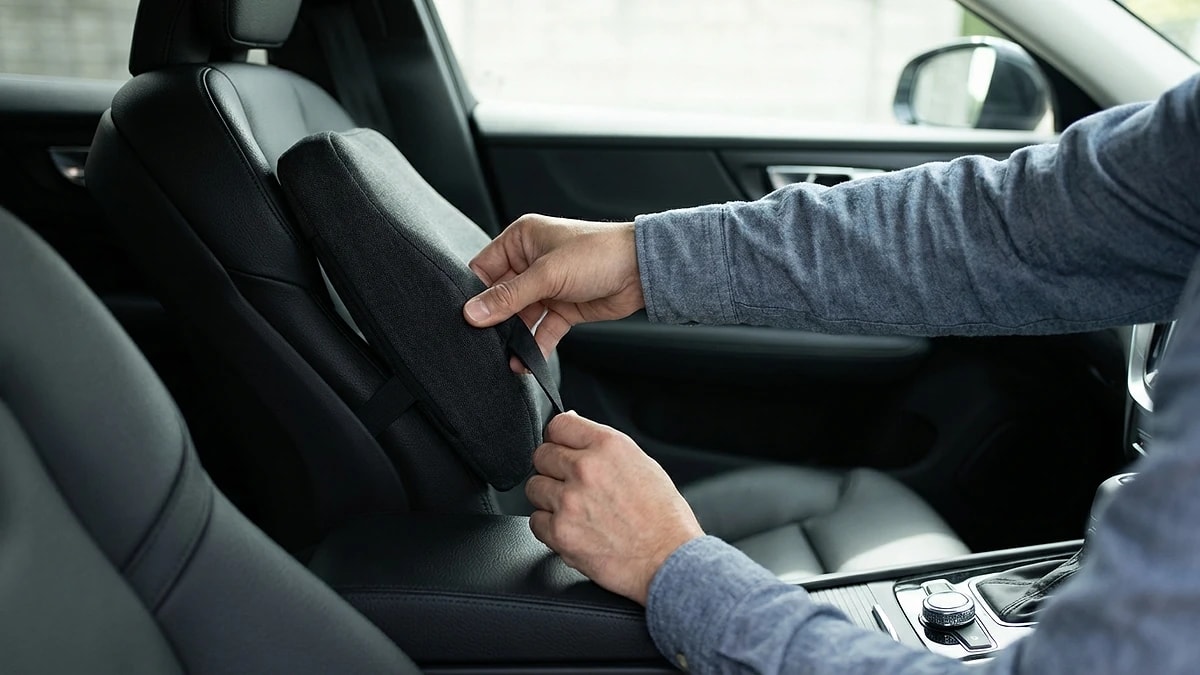
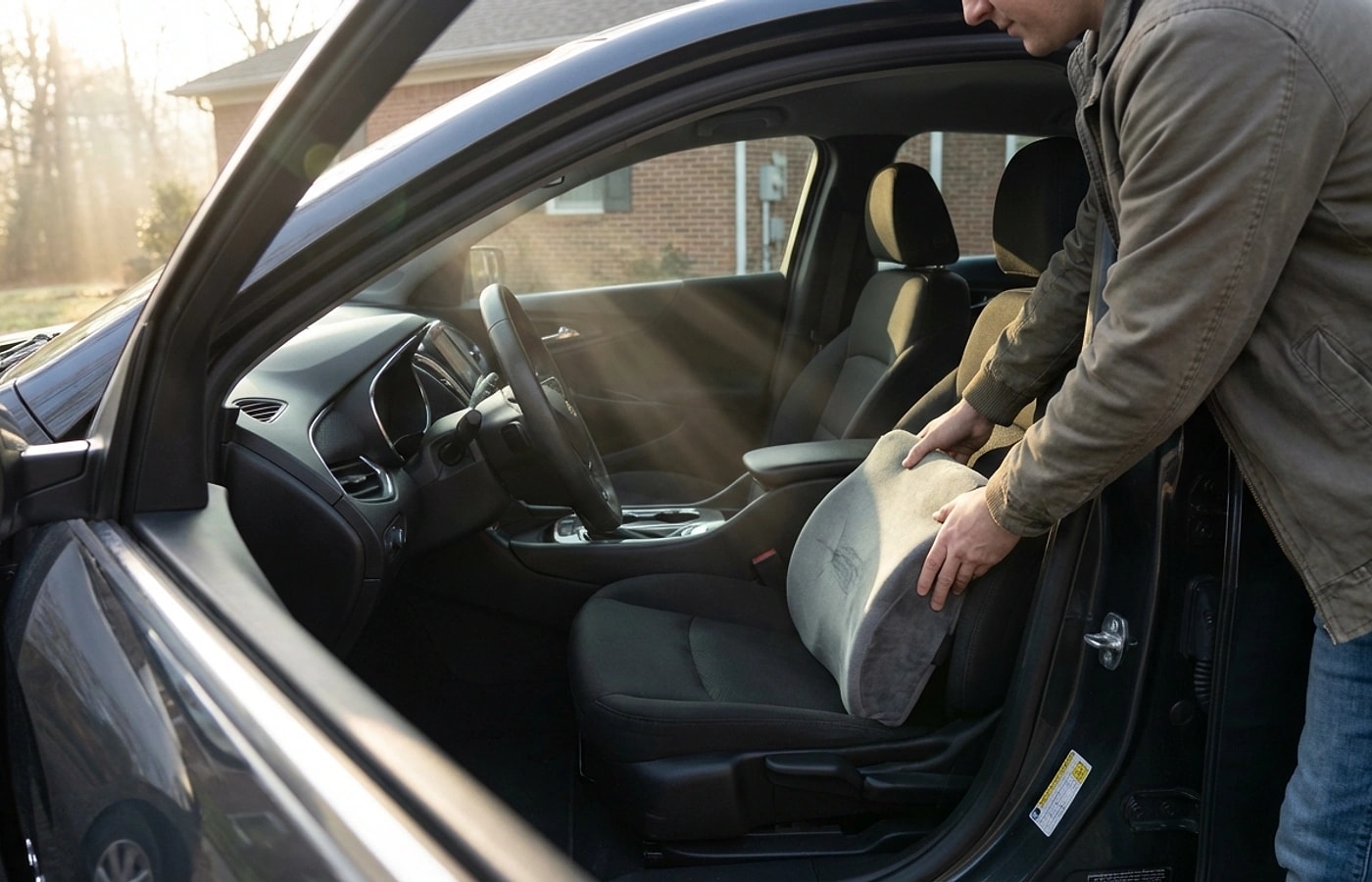
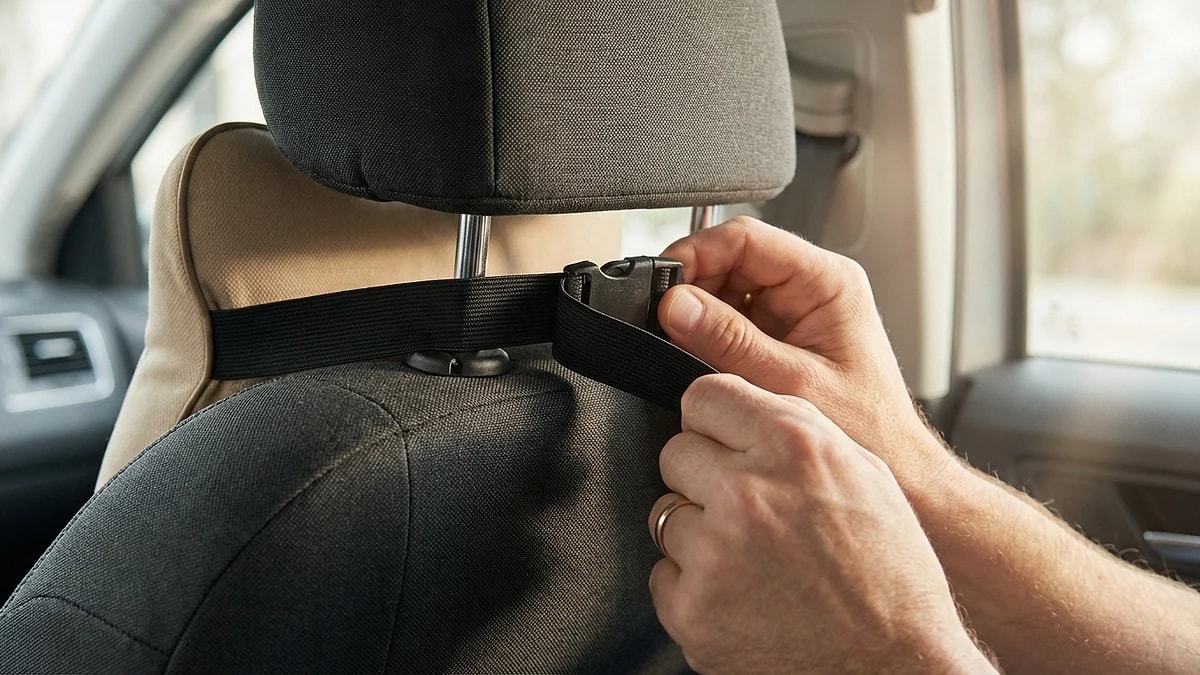
Always do the initial setup with the engine off and the car parked. Sit in your normal driving position with feet on pedals and hands at 9-and-3 on the wheel. Place the lumbar support at your belt line — the natural inward curve of your lower back — and secure the strap behind the seat back. The strap should route between the seat and the headrest post area, not at the very bottom where it will slide off.

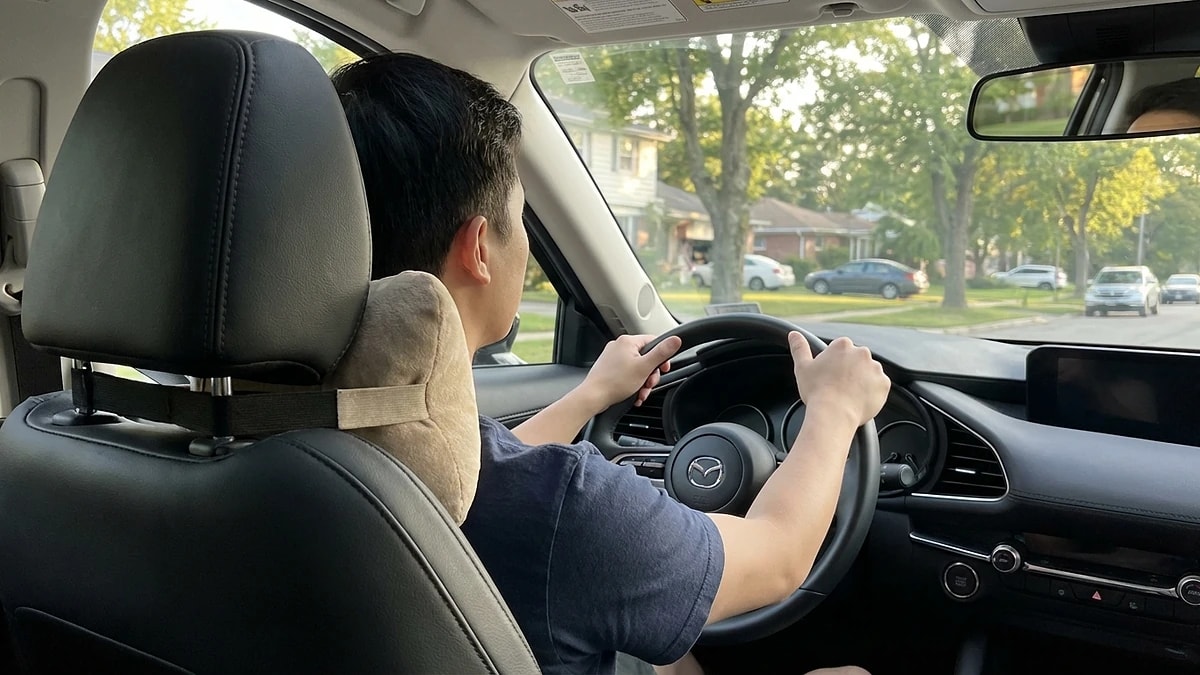
Once strapped, lean back fully into the seat and check three things. First, your shoulders should touch the seat back naturally without being pushed forward. Second, your arms should reach the steering wheel at 9-and-3 with a slight elbow bend — if you are reaching or your elbows are locked, the pillow is too thick. Third, check all three mirrors without moving your head more than usual. Any of these failing means you need a thinner profile or lower position.

  • Park and turn off engine before any setup adjustments
  • Sit in normal driving position with feet on pedals, hands at 9-and-3
  • Route strap between seat back and headrest post area
  • Verify: shoulders touch seat, elbows bend at wheel, mirrors clear
Preventing drift during long drives

Preventing drift during long drives

The most common complaint with car lumbar support is downward drift — the pillow gradually slides toward the seat bottom during a drive, losing contact with your lower back. This happens because road vibration loosens elastic straps over time, and the natural weight of your torso pressing the pillow against a smooth seat surface creates slow downward migration.

To prevent drift, use a non-slip material between the pillow back and the seat surface — a thin rubber shelf liner cut to size works well and costs almost nothing. For the strap, check that it is routed through a fixed anchor point rather than resting on smooth upholstery. Some drivers add a small Velcro strip to the pillow back and seat surface for secure attachment. After every long drive, do a quick position check before your next trip.

  • Place non-slip rubber liner between pillow and seat surface
  • Route strap through fixed anchor points, not smooth surfaces
  • Velcro strips between pillow and seat prevent migration entirely
  • Quick position check after every long drive takes 5 seconds
Safety checks you must not skip

Safety checks you must not skip

Lumbar support should never compromise your ability to control the vehicle. After any pillow change or repositioning, run through a complete safety check while parked: confirm you can press the brake and clutch pedals fully without your back lifting off the seat, verify you can turn the steering wheel through its full range without shoulder restriction, and check that your seatbelt sits correctly across your chest and lap without the pillow pushing it to an awkward angle.

If you share the car with another driver, each person needs their own adjustment protocol. Mark your ideal strap position with a small piece of tape or a strap marker so you can reset quickly. Never adjust lumbar support while driving — if the pillow shifts mid-trip, pull over safely before repositioning. Distracted driving from fiddling with support accessories is an avoidable risk.

  • Full pedal reach test: brake and clutch without back lifting
  • Full steering range without shoulder restriction
  • Seatbelt position check: correct across chest and lap
  • Never adjust while driving — pull over for repositioning
Your first-week adaptation plan

Your first-week adaptation plan

Your body needs time to adapt to the new seated position, especially if you have been driving without lumbar support for months or years. During the first week, resist the urge to make large adjustments — your muscles need to recalibrate to the supported posture. Stick with the initial placement for at least three full drives before making any changes, and keep those changes small: one centimeter up or down, or a slight strap tightening.

Track your experience simply: rate your end-of-drive comfort on a 1-to-10 scale. Most drivers see improvement by day three to four as their muscles stop compensating for the old unsupported position. If comfort is declining rather than improving after five days, the pillow depth is likely wrong for your seat — try a thinner or flatter profile before giving up on lumbar support entirely.

  • Keep initial placement for at least 3 full drives before adjusting
  • Make changes in small increments — 1cm repositioning maximum
  • Rate end-of-drive comfort (1-10) to track adaptation
  • Expect improvement by day 3-4 as muscles recalibrate

Dazniausiai uzduodami klausimai

Can lumbar support affect steering comfort?

Yes — if the pillow is too thick it pushes your torso forward, reducing steering reach. Always verify full steering range with a slight elbow bend after any adjustment.

Where should the strap anchor on a car seat?

Route the strap between the seat back and the headrest post area. Avoid anchoring at the very bottom of the seat where it slides off during driving vibration.

How long does it take to find the right car setup?

Most drivers finalize their setup within one week of daily driving. Stick with the initial position for three drives before making small adjustments.

Should I disable my car's built-in lumbar support?

Yes — running both creates unpredictable pressure. Set the built-in system to its lowest or off position before adding an external lumbar pillow.

Can I use the same lumbar pillow for car and office?

You can, but car seats require different strap routing and slightly higher placement. Many users find it easier to have a dedicated pillow for each context.

Susije gidai

Naršykite šiuos gidus, kad sužinotumėte daugiau ir rastumėte tinkamą sprendimą.