
5 Desk Exercises to Relieve Lower Back Pain
If you have ever stood up from your desk and felt that familiar tightness radiating across your lower back, you are not alone. Research from Cornell University's ergonomics department estimates that over 54% of office workers experience recurrent low back pain, much of it directly attributable to prolonged sitting. The good news is that a handful of simple desk exercises for back pain can make a measurable difference, and you do not need a gym, special equipment, or even a change of clothes.
This guide covers five targeted exercises, the science behind why they work, and a practical routine you can complete in under ten minutes at your desk.
Why Sitting Causes Back Pain: The Science
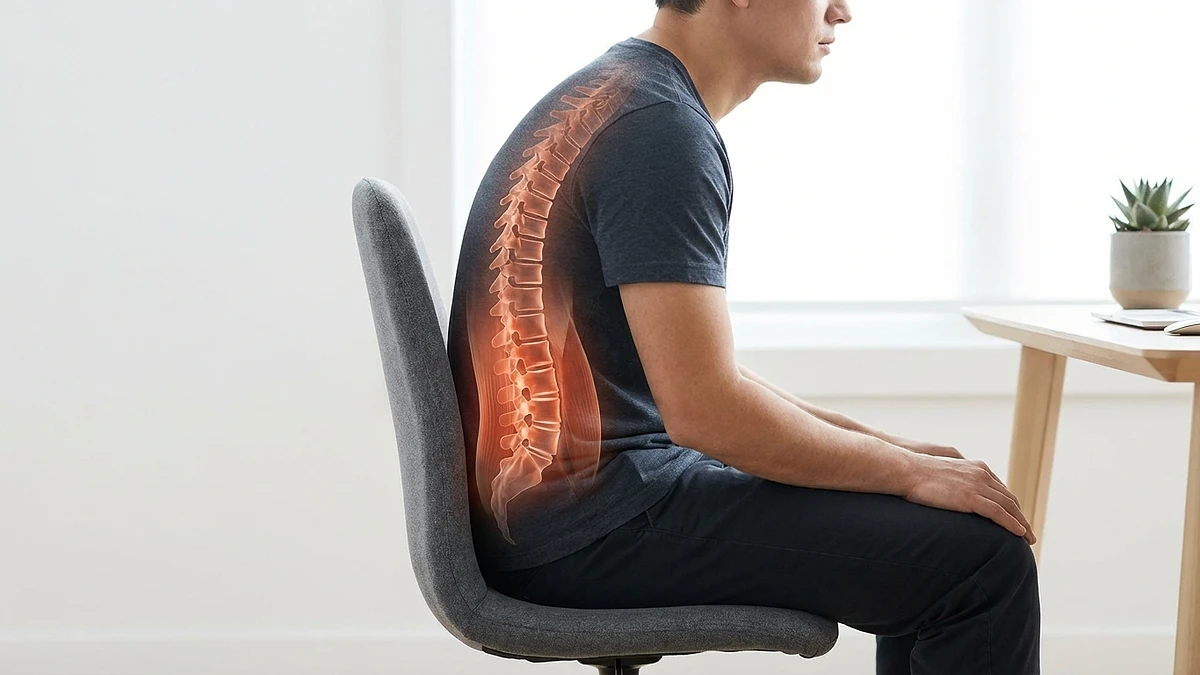
Understanding why your back hurts is the first step toward fixing it. When you sit, several things happen simultaneously that conspire against your lower back.
First, your hip flexors shorten. These muscles connect your lumbar spine to your thigh bones, and when they tighten, they pull your pelvis into an anterior tilt that increases compression on the lumbar discs. A study in the Journal of Orthopaedic and Sports Physical Therapy found that hip flexor tightness is one of the strongest predictors of low back pain in sedentary workers.
Second, your glutes deactivate. Sitting essentially turns off the largest muscles in your body, and when your glutes stop firing, your lower back muscles compensate by working overtime to stabilize your pelvis. This leads to fatigue, spasm, and pain.
Third, your spinal discs lose hydration. Intervertebral discs absorb water during movement and lose it during static loading. After several hours of sitting, the discs in your lumbar spine are measurably thinner and less resilient, which is why your back feels worst at the end of the day.
The exercises in this guide specifically target these three mechanisms: they lengthen the hip flexors, reactivate the glutes and core, and restore movement to the spinal joints to promote disc hydration.
Important Disclaimer
These exercises are intended for general muscular tightness and discomfort from prolonged sitting. If you have a diagnosed spinal condition, herniated disc, recent injury, or pain that radiates down your legs, consult a healthcare professional before attempting any new exercises. Stop immediately if any movement causes sharp pain, numbness, or tingling.
Exercise 1: Seated Cat-Cow Stretch
The seated cat-cow is a modified version of the yoga pose that targets spinal mobility through flexion and extension. It gently mobilizes each segment of your spine and promotes fluid exchange in the intervertebral discs, which is exactly what your back craves after hours of static sitting.
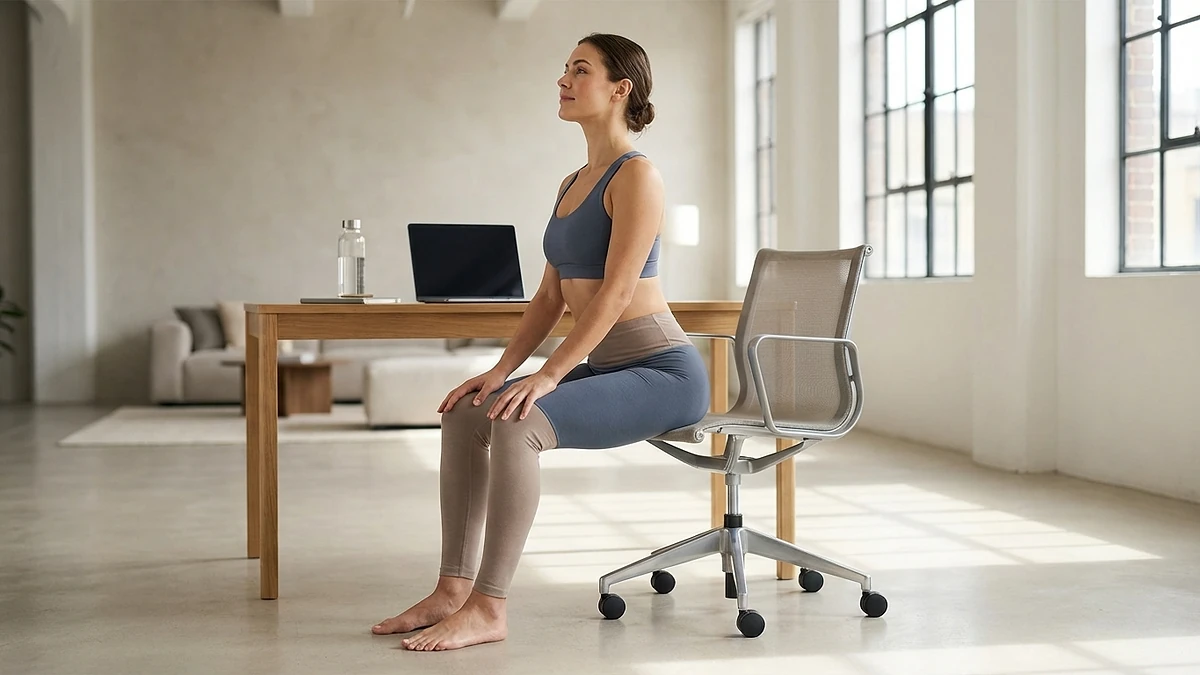
How to perform it:
- Sit at the front edge of your chair with your feet flat on the floor, hip-width apart. Place your hands on your knees.
- Cow phase: Inhale and arch your back, rolling your shoulders back and lifting your chest toward the ceiling. Let your belly move forward and your tailbone tilt back. Hold for two seconds.
- Cat phase: Exhale and round your spine, tucking your chin toward your chest and drawing your navel toward your spine. Let your shoulders roll forward and your tailbone tuck under. Hold for two seconds.
- Flow between the two positions slowly, spending about four seconds on each phase. Complete 8-10 full cycles.
Why it works: This movement takes your lumbar spine through its full range of flexion and extension, which pumps fluid into the discs and reduces stiffness in the spinal ligaments. Research in Spine journal has shown that repeated spinal flexion-extension movements can reduce intradiscal pressure and improve self-reported pain scores in sedentary workers.
Exercise 2: Seated Spinal Twist
Rotational movement is often neglected in the office setting, yet your spine is designed to twist. When you sit motionless for hours, the rotational muscles (obliques and multifidus) stiffen and the facet joints in your spine lose their glide.
How to perform it:
- Sit tall with your feet flat on the floor. Cross your right leg over your left at the knee if comfortable, or keep both feet grounded.
- Place your left hand on the outside of your right knee. Place your right hand on the armrest or behind you on the seat.
- Inhale to lengthen your spine upward, then exhale as you rotate gently to the right. Lead with your chest, not your neck. Look over your right shoulder only as far as is comfortable.
- Hold for 15-20 seconds, breathing normally. With each exhale, see if you can rotate a fraction further without forcing.
- Return to center and repeat on the other side. Complete 2-3 holds per side.
Why it works: The twist mobilizes the thoracolumbar junction, where your mid-back meets your lower back, a common site of stiffness in desk workers. It also engages the oblique muscles, which play a crucial role in spinal stabilization but are essentially dormant during sitting.
Exercise 3: Standing Hip Flexor Stretch
Tight hip flexors are one of the primary drivers of lower back pain in office workers. The iliopsoas muscle, which runs from your lumbar spine through your pelvis to your femur, shortens progressively during sitting. When you stand, this shortened muscle pulls on your lower vertebrae, creating a compressive load that your back muscles struggle to counteract.
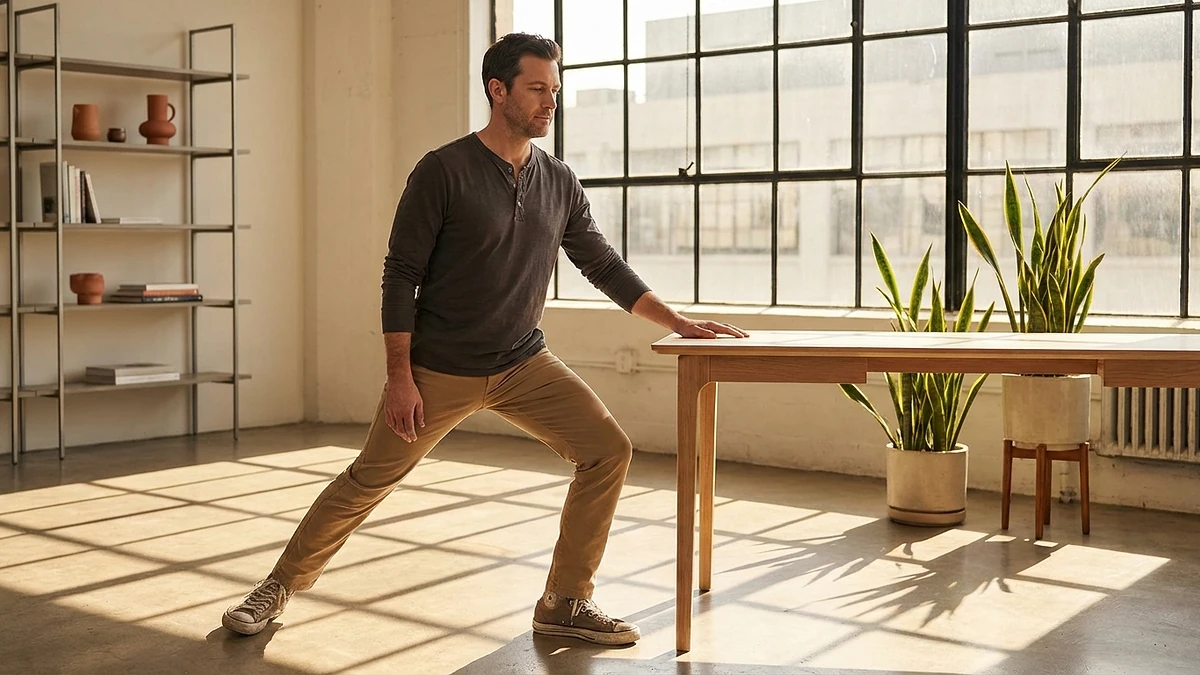
How to perform it:
- Stand beside your desk with one hand resting on it for balance.
- Step your right foot forward into a split stance, roughly two feet apart.
- Keeping your torso upright, bend your right knee and shift your hips forward until you feel a stretch at the front of your left hip. Your left heel will lift off the floor.
- Squeeze your left glute gently to deepen the stretch. Avoid arching your lower back.
- Hold for 20-30 seconds, then switch sides. Repeat twice per side.
Why it works: A meta-analysis published in the Journal of Physical Therapy Science found that hip flexor stretching performed two to three times daily significantly reduced low back pain intensity in office workers over a four-week period. The effect was additive with other stretches and ergonomic interventions.
Exercise 4: Figure-Four Stretch
The figure-four targets the piriformis and deep external rotators of the hip. These muscles tighten during prolonged sitting and can compress the sciatic nerve, contributing to a pattern of deep buttock and lower back pain that many office workers mistake for a disc problem.
How to perform it:
- Sit at the front edge of your chair with both feet on the floor.
- Cross your right ankle over your left knee, letting your right knee fall open to the side. Flex your right foot slightly to protect the knee.
- Sit tall and hinge forward from your hips, keeping your back straight. You should feel a deep stretch in your right buttock and outer hip.
- Hold for 20-30 seconds, breathing steadily. Do not round your back to go deeper; hinge at the hips instead.
- Switch sides and repeat. Complete 2-3 holds per side.
Why it works: By lengthening the deep hip rotators, you relieve tension that is transmitted upward into the sacroiliac joint and lumbar spine. If you experience sciatica-like symptoms, this stretch can be particularly effective, though it is important to consult a professional if symptoms persist.
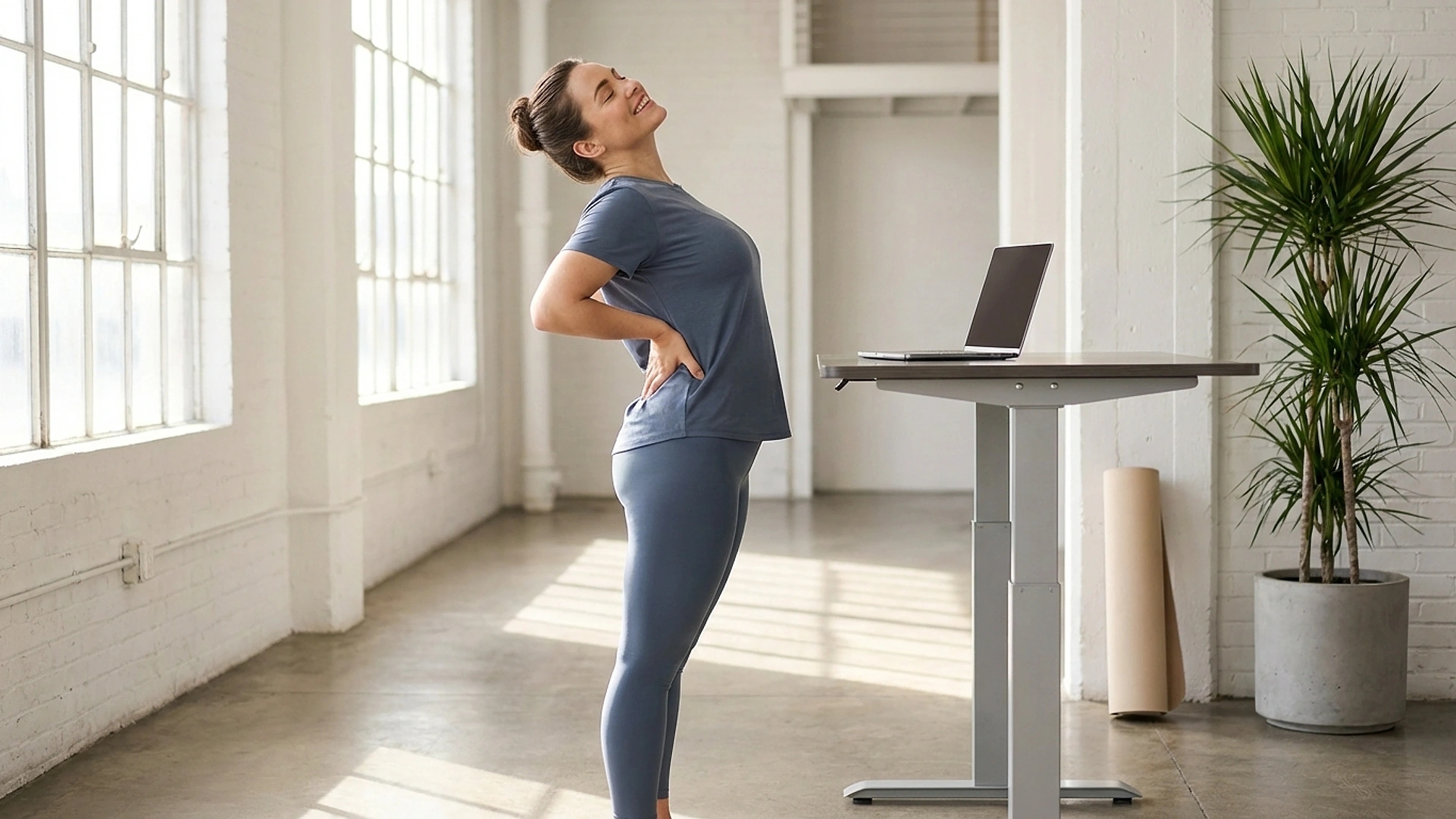
Exercise 5: Standing Back Extension
After hours of forward-flexed sitting, your lumbar spine benefits from gentle extension in the opposite direction. The standing back extension is a safe, controlled way to reverse the cumulative flexion load of desk work.
How to perform it:
- Stand with your feet hip-width apart and place your hands on your lower back, fingers pointing downward.
- Slowly lean backward, supporting your lower back with your hands. Go only as far as is comfortable, typically 10-20 degrees of extension.
- Hold the extended position for 2-3 seconds, then return to upright. Do not bounce or jerk into the movement.
- Repeat 8-10 times. You should feel a gentle stretch across your abdomen and a mild compression relief in your lower back.
Why it works: The McKenzie method, developed by physiotherapist Robin McKenzie, has shown that repeated lumbar extensions can help centralize disc material that migrates posteriorly during flexion-dominant activities like sitting. Even in people without disc problems, the movement restores the natural lordotic curve and relieves tension in the posterior spinal ligaments.
Common Mistakes to Avoid
These exercises are simple, but there are patterns that reduce their effectiveness or create new problems.
- Stretching through pain. Discomfort is acceptable. Sharp or shooting pain is not. If any exercise triggers pain beyond mild stretching sensation, stop and modify the movement or skip it entirely.
- Holding your breath. Breath-holding increases intra-abdominal pressure and muscle tension, which is counterproductive when trying to release tightness. Breathe slowly and steadily throughout each exercise.
- Rushing through the routine. Connective tissue needs time under gentle stretch to lengthen. Holding each stretch for less than 15 seconds provides minimal benefit. Take your time.
- Only stretching when pain appears. The goal is prevention, not rescue. By the time you feel significant pain, your tissues are already inflamed and less responsive to stretching. Build the routine into your day before symptoms arise.
- Neglecting one side. Most people have asymmetries. If your right hip is tighter than your left, spend extra time on that side rather than doing equal repetitions and calling it done.
Building a 10-Minute Daily Routine
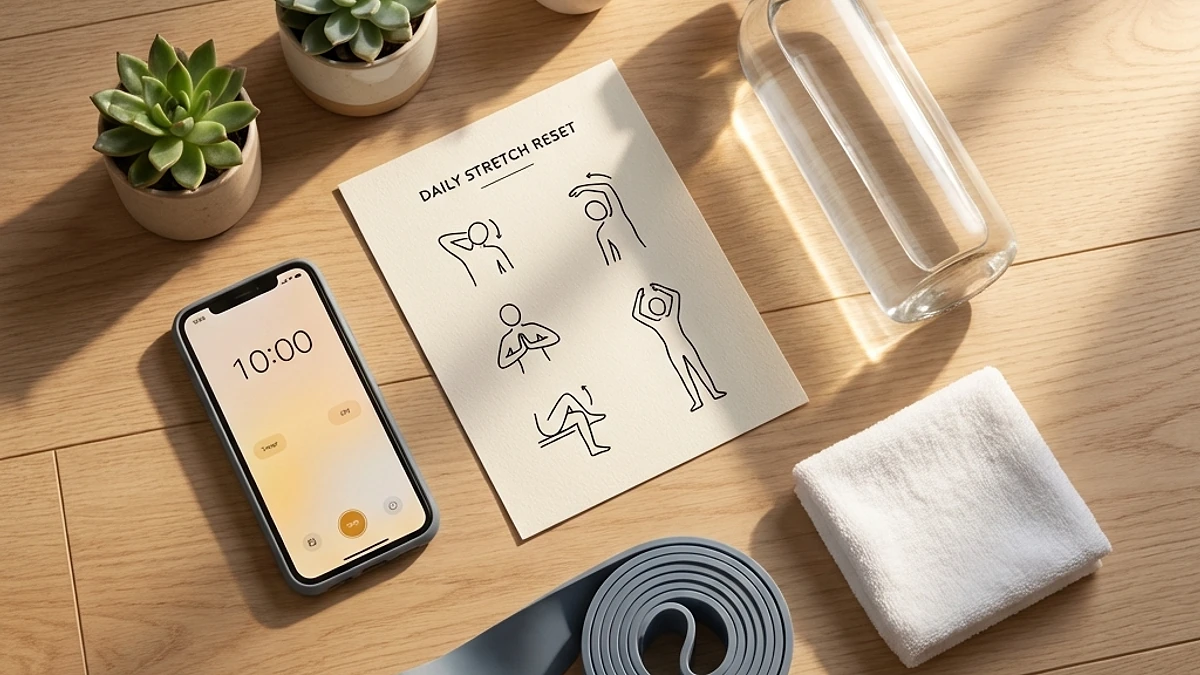
Here is how to combine all five exercises into a structured routine that you can perform at your desk once in the morning and once in the afternoon.
- Seated cat-cow: 10 cycles (2 minutes). This serves as your warm-up, gently mobilizing the spine before deeper stretches.
- Seated spinal twist: 2 holds per side, 20 seconds each (2 minutes). Move directly from cat-cow into the twist while you are already seated.
- Standing hip flexor stretch: 2 holds per side, 25 seconds each (2 minutes). Stand up smoothly and use your desk for balance.
- Figure-four stretch: 2 holds per side, 25 seconds each (2 minutes). Return to your chair for this seated stretch.
- Standing back extension: 10 repetitions (2 minutes). Finish on your feet, which gives you a natural transition back to work or a walk to the kitchen.
Total time: approximately 10 minutes. If you can only do this once per day, schedule it for the early afternoon when spinal disc dehydration and muscle fatigue tend to peak.
Creating a Routine That Sticks
Knowledge alone rarely changes behavior. The difference between people who stretch daily and people who intend to is usually a system, not willpower. Here are strategies backed by behavioral research to help you build a lasting habit.
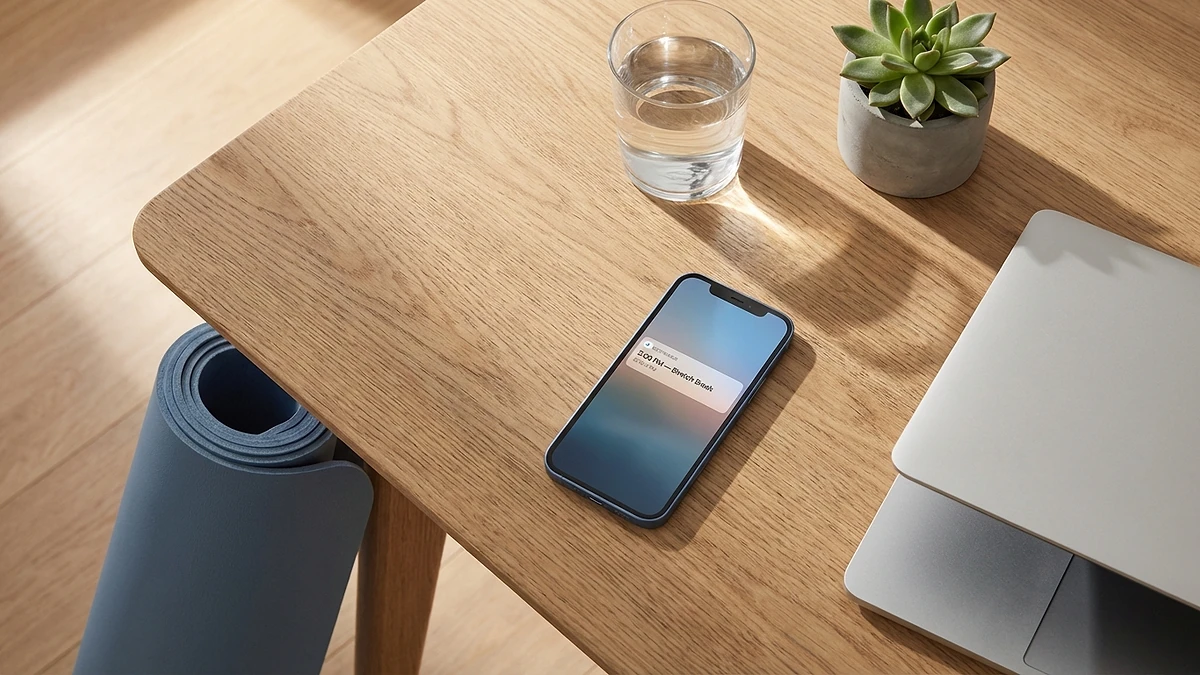
- Set a recurring timer. Use your phone or calendar to trigger a stretch break at the same times every day. After two weeks, the cue becomes automatic.
- Anchor it to an existing habit. Do your routine immediately after your morning coffee or right after lunch. Pairing new behaviors with established ones dramatically increases adherence.
- Start smaller than you think. If ten minutes feels like too much, start with just the cat-cow and hip flexor stretch. Two exercises done consistently beats five exercises done sporadically.
- Track your streaks. A simple checkmark on a calendar creates a visual chain that you become reluctant to break. This technique, often called the Seinfeld method, is remarkably effective for daily habits.
Complementary Support: Pairing Exercises with Equipment
Stretching addresses the movement deficit of desk work, but it cannot fix a fundamentally unsupportive workspace. For the best results, combine your exercise routine with ergonomic equipment that supports your body between stretch breaks.
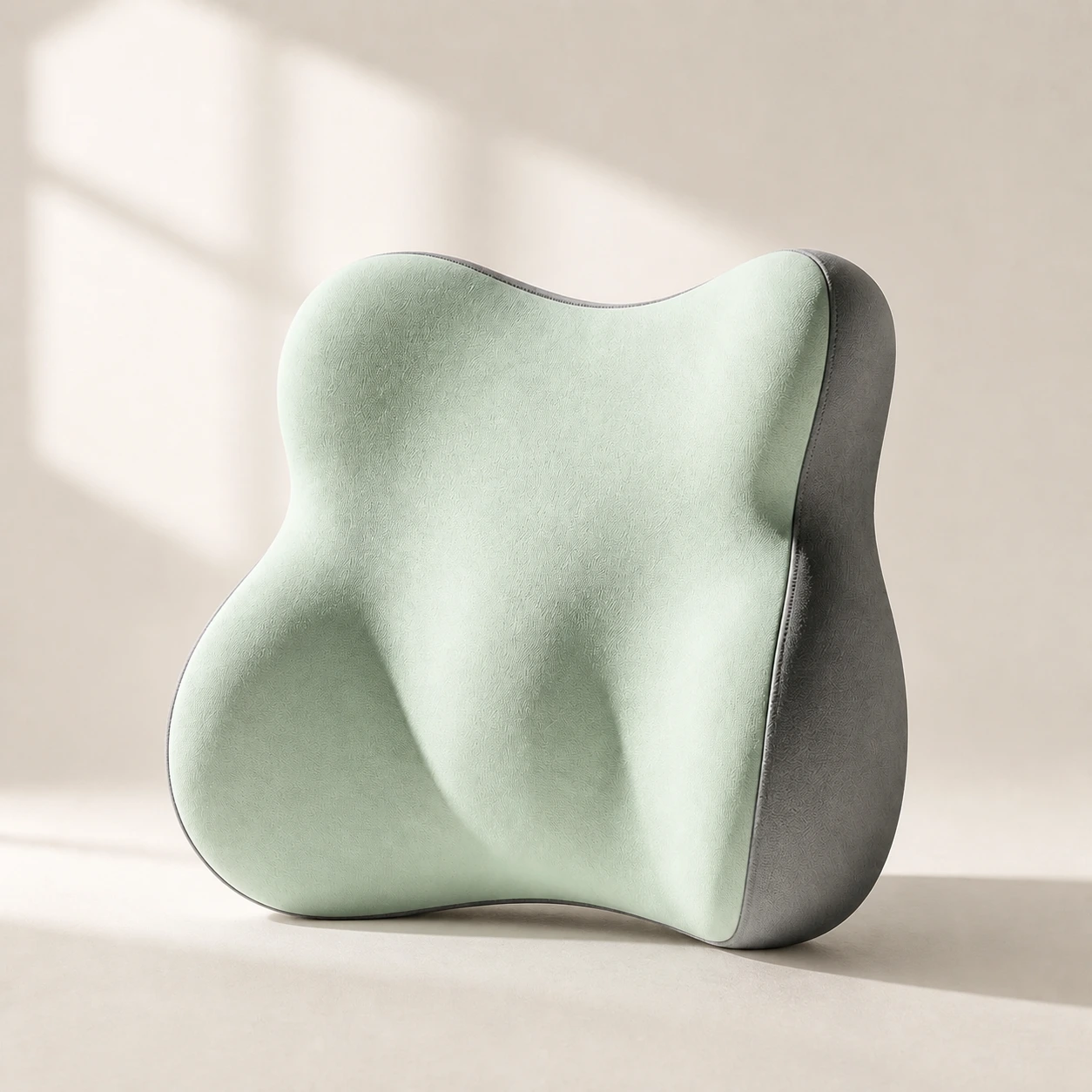 Product mentioned in this guideLumaWing Lumbar Cushion39 × 34 × 14 cm lumbar cushion available in four colours with a slow-rebound memory-foam core, fixed central ridge, recessed side channels, and broad outer…Free US shipping on every order60-Day Home Trial · we pay return shippingSee current price
A lumbar support pillow maintains your spinal curve during the hours you are not stretching, reducing the cumulative flexion load that causes the tightness in the first place. An ergonomic seat cushion redistributes sitting pressure away from your tailbone and ischial tuberosities, reducing the compression that contributes to piriformis tightness and sciatic irritation.
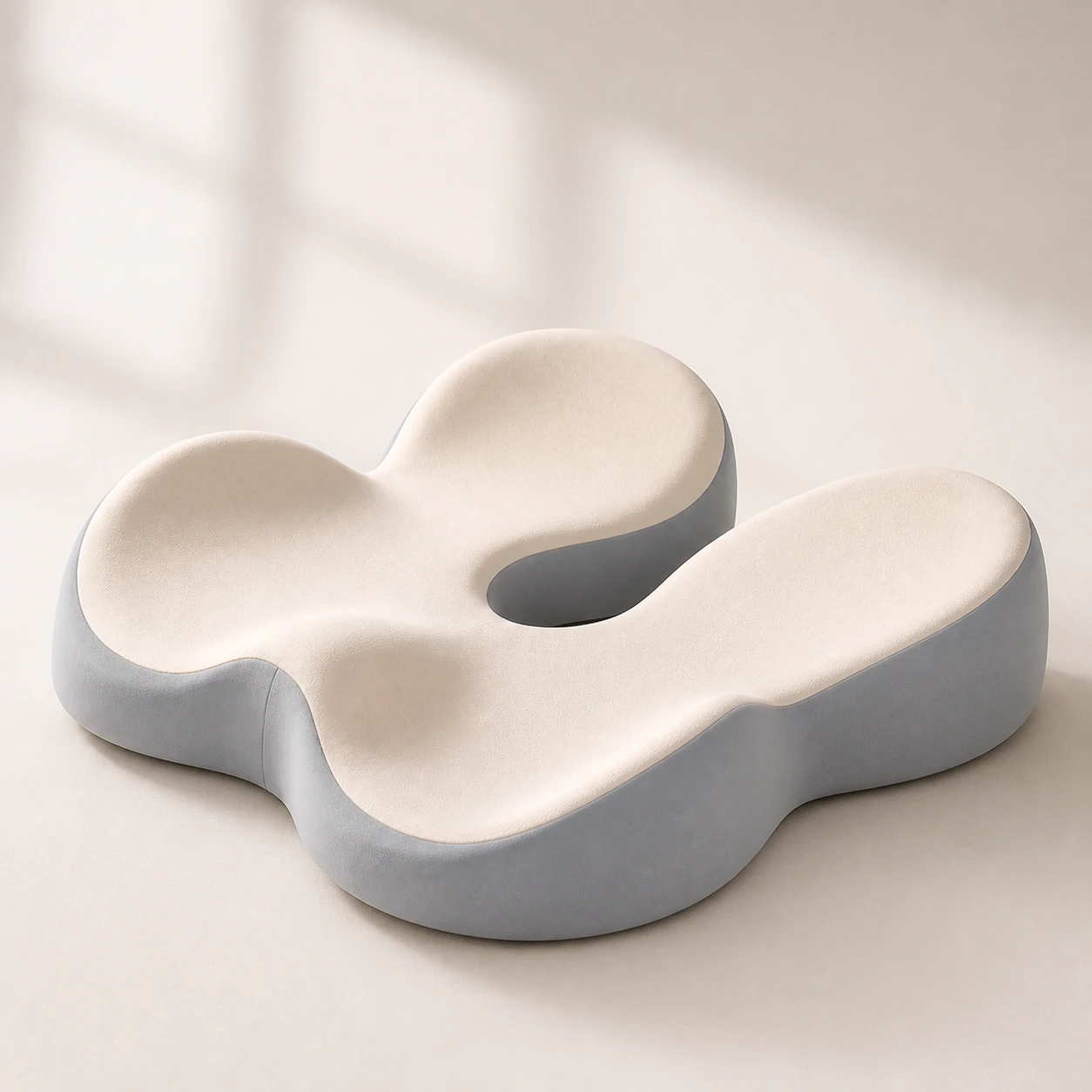 Product mentioned in this guideMemory Foam Seat CushionA sculpted seat cushion with a deep, open U-shaped rear channel designed to reduce direct contact beneath the coccyx and tailbone area. Raised rear…Free US shipping on every order60-Day Home Trial · we pay return shippingSee current price
Think of it as a two-pronged strategy: your exercises restore mobility and activate dormant muscles, while your equipment maintains those gains throughout the workday. Neither approach is as effective alone as they are together.
For a comprehensive look at building a supportive workspace, see our ergonomic home office setup checklist.