Spring sale — 40% off + free shipping

Solutions

Lumbar Support for Car

Complete car lumbar support guide: compare pillow profiles, cushion materials, strap systems, and seat-fit by vehicle type for daily commute and long drives.

Lumbar Support for Car

Key takeaways

Driving posture needs stable support with minimal slipping.
Lower-vibration materials help maintain comfort during long trips.
Fit should be validated per seat shape and driving duration.
High-density foam and gel-infused options outperform budget materials in car use.
What matters in a car setup

What matters in a car setup

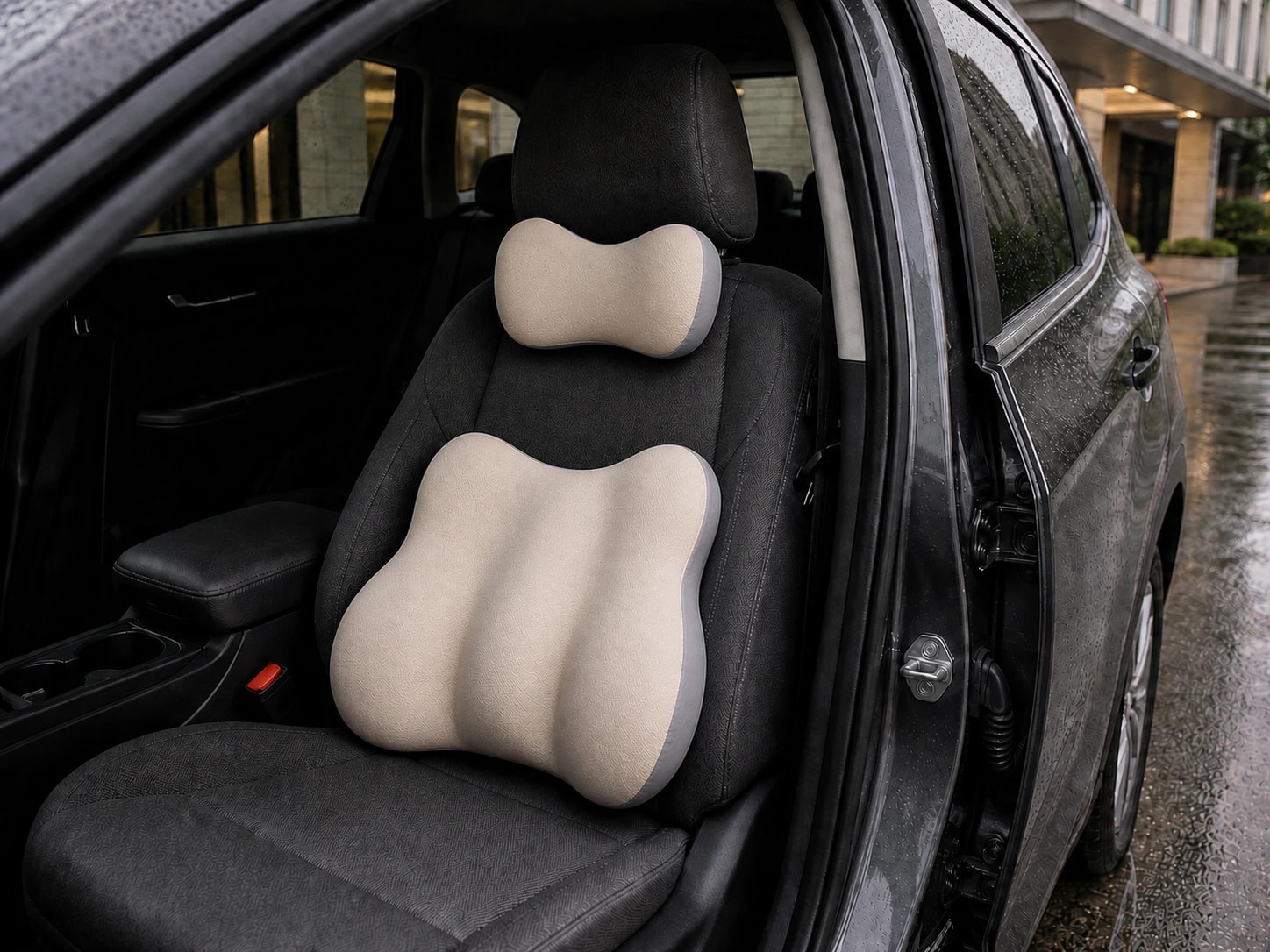
Vehicle seats vary dramatically in contour depth, angle, and surface material, which means one-size-fits-all assumptions frequently lead to poor lumbar pillow performance. Bucket seats with deep side bolsters require slim-profile supports that do not compete for space, while flatter seatbacks can accommodate fuller contour pillows. The critical measurement is the gap between your lower back and the seatback when you are in your normal driving position — the pillow should fill this gap without pushing your torso forward.

Strap durability matters more in cars than in office chairs because of constant road vibration. A pillow that stays in place on a stationary office chair may shift repeatedly during highway driving. Look for supports with anti-slide backing material and adjustable elastic straps that route around the seatback headrest post or through the gap between seat and backrest.

  • Check fit for bucket seats vs flat seatbacks before purchasing
  • Measure the gap between lower back and seat in driving position
  • Avoid bulky profiles that push torso too far forward from the seatback
  • Prioritize anti-slide backing to handle road vibration
Seat-fit by vehicle type

Seat-fit by vehicle type

Car seat compatibility is the single biggest factor in lumbar pillow satisfaction. Deep-bucket seats found in sports cars and performance vehicles have aggressive side bolsters that leave very little space between your lower back and the seat surface. In these vehicles, a slim-profile support (under 3 inches deep) with a narrow footprint works significantly better than full-contour pillows that compete for space with the bolsters.

Flatter seatbacks in sedans, SUVs, and trucks can accommodate larger contour pillows because there is more clearance between your spine and the seat. The deciding factor becomes strap stability — larger pillows have more weight and surface area to shift during driving, so they need stronger attachment systems. Test by pressing firmly against the pillow while turning the steering wheel through its full range to verify it stays anchored.

  • Bucket seats: slim profile under 3 inches, narrow footprint
  • Flat seats: full contour okay if strap system is secure
  • Test stability during full steering wheel rotation
  • Check that pillow edges do not interfere with seat bolsters
Comfort and safety considerations

Comfort and safety considerations

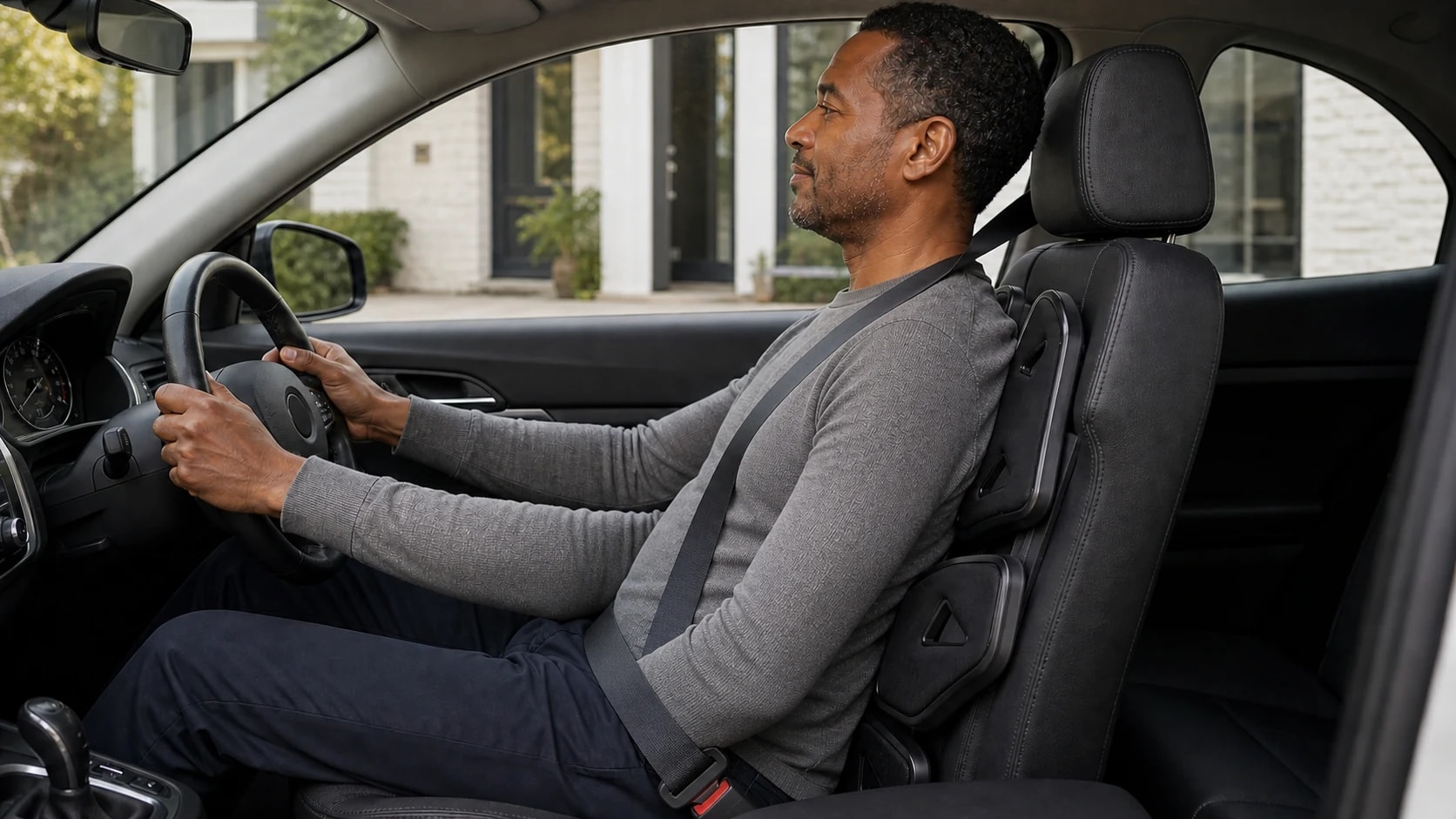
Lumbar support should improve driving comfort without compromising vehicle control. After installing any support device, check three critical safety points: steering wheel reach should remain comfortable without arm extension, all mirrors should maintain their original sightlines, and pedal operation should feel unchanged. If any of these are affected, the support profile is likely too thick for your seat configuration.

Seatbelt fit is another overlooked factor. A thick lumbar pillow can shift your torso position enough to change where the shoulder belt crosses your chest. The belt should rest across the center of your shoulder and across your chest — not riding up on your neck or slipping off the shoulder. Re-route the belt after installation and verify it locks properly during a hard brake test in a safe area.

  • Verify steering reach, mirror alignment, and pedal control after installation
  • Check seatbelt path across shoulder and chest after positioning pillow
  • Re-fit immediately if any driving control is compromised
Cushion materials and foam density

Cushion materials and foam density

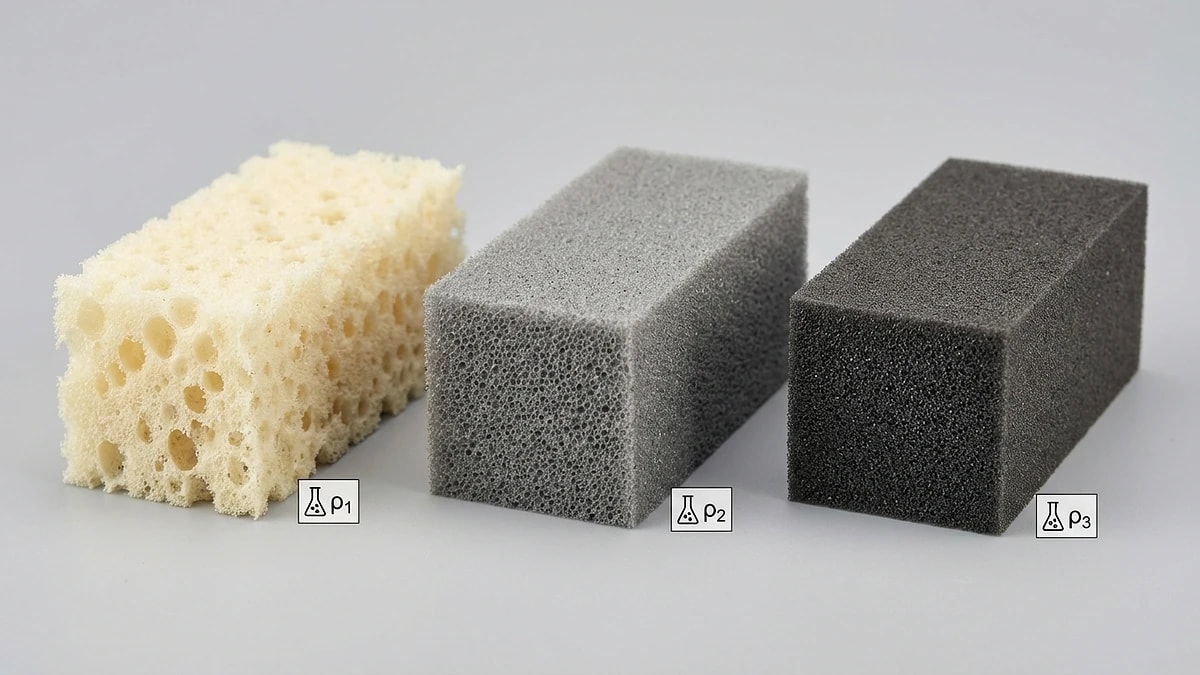
Memory foam density is the primary predictor of long-term performance in car lumbar cushions. Foam rated at 3.5 to 4.5 pounds per cubic foot maintains its contour through months of daily driving and road vibration, while lower-density options (under 3 lbs/ft³) often feel comfortable initially but compress permanently within weeks. The higher upfront cost of dense foam pays off in durability — expect roughly double the functional lifespan compared to budget foam options.

Gel-infused memory foam addresses the heat retention problem that standard foam creates in enclosed vehicle cabins. During summer months, a standard memory foam cushion can become uncomfortably warm within 30 minutes of driving. Gel infusion distributes heat more evenly across the surface, reducing hot spots by approximately 20 to 30 percent. For drivers in warm climates or those without strong vehicle air conditioning, this material upgrade significantly improves daily comfort.

  • High-density foam (3.5-4.5 lb/ft³) for best long-term performance
  • Low-density foam (under 3 lb/ft³) compresses permanently within weeks
  • Gel-infused foam reduces heat buildup by 20-30% in enclosed cabins
  • Consider climate when choosing between standard and gel-infused foam
Vibration resistance and seasonal care

Vibration resistance and seasonal care

Road vibration is the primary durability challenge for car lumbar supports. Highway driving generates constant micro-movements that accelerate foam fatigue compared to stationary office use. High-density memory foam with a minimum density of 3.5 pounds per cubic foot typically handles vibration stress better than lower-density alternatives, maintaining its contour shape over months of daily driving.

Heat is another car-specific factor. Interior temperatures in parked vehicles can exceed 140°F in summer, which accelerates memory foam degradation. If you live in a hot climate, consider removing the lumbar pillow when parking for extended periods or choosing a gel-infused foam that tolerates higher temperatures without permanent compression damage. In winter, cold memory foam becomes temporarily rigid and takes 10 to 15 minutes of body heat to reach its normal contouring responsiveness — this is normal behavior.

  • High-density foam (3.5+ lb/ft³) resists vibration fatigue better
  • Remove pillow from parked cars in extreme heat to extend foam life
  • Gel-infused foam handles high temperatures better than standard memory foam
  • Winter: allow 10-15 minutes for cold foam to warm and soften
Comparing support types: pillow vs cushion vs roll

Comparing support types: pillow vs cushion vs roll

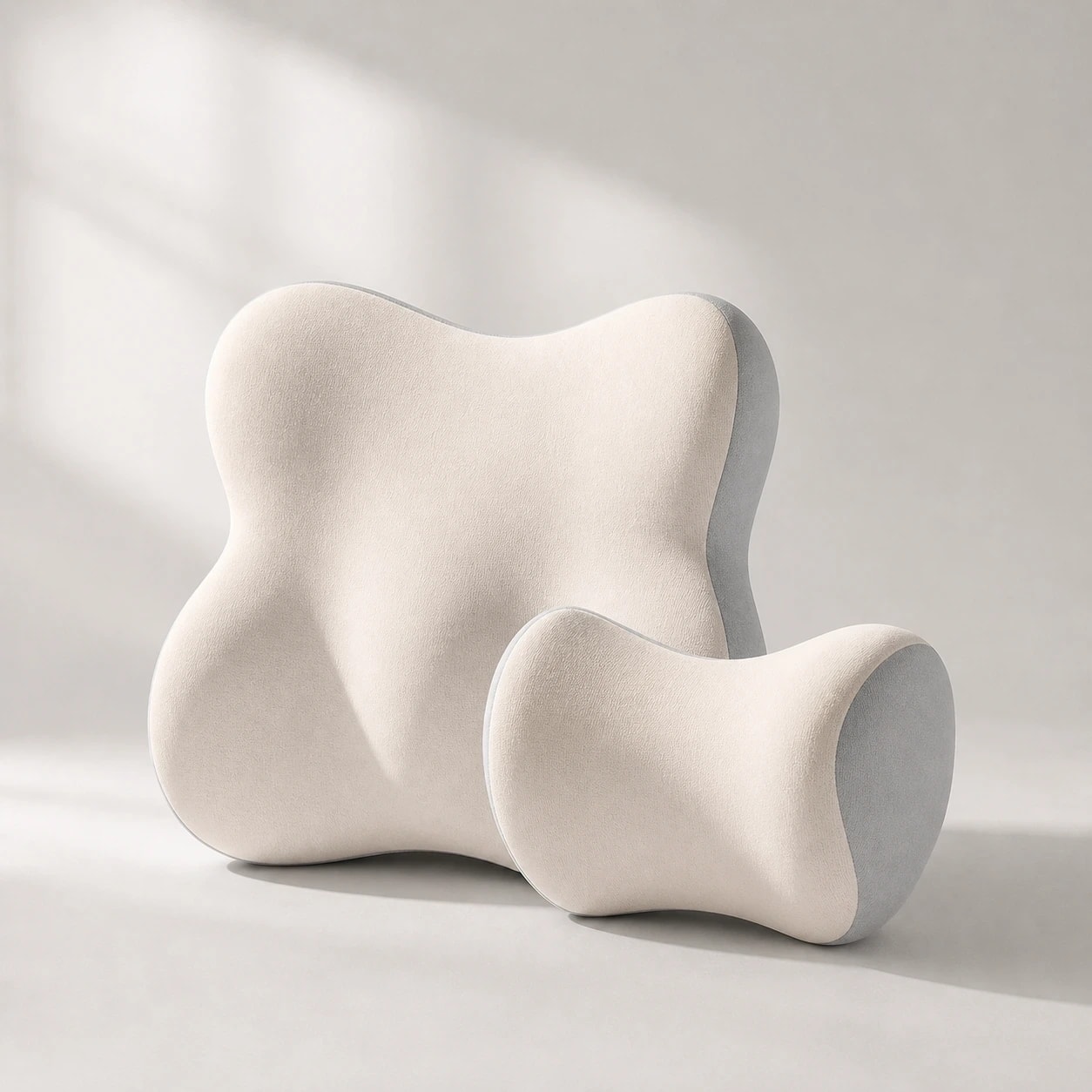
Lumbar pillows provide the broadest support surface and are best suited for drivers who maintain a relatively consistent seated position throughout their drive. They distribute pressure across a wider area of the lower back, which most daily commuters find comfortable. The tradeoff is bulk — pillows are the largest option and may not fit well in compact car seats.

Lumbar rolls offer a more focused pressure point and take up less space, making them ideal for tight-fitting sports car seats or for users who prefer precise, localized support. Seat cushions address an entirely different problem — they improve the pressure interface at the sitting surface rather than the lumbar region. For comprehensive driving comfort, many experienced users combine a lumbar pillow or roll with a separate seat cushion.

  • Pillows: broadest support, most bulk, best for standard seats
  • Rolls: focused pressure, compact, ideal for tight sports seats
  • Seat cushions: address sitting surface pressure, not lumbar alignment
  • Best results often come from combining lumbar support with seat cushion
Installation tips and multi-vehicle use

Installation tips and multi-vehicle use

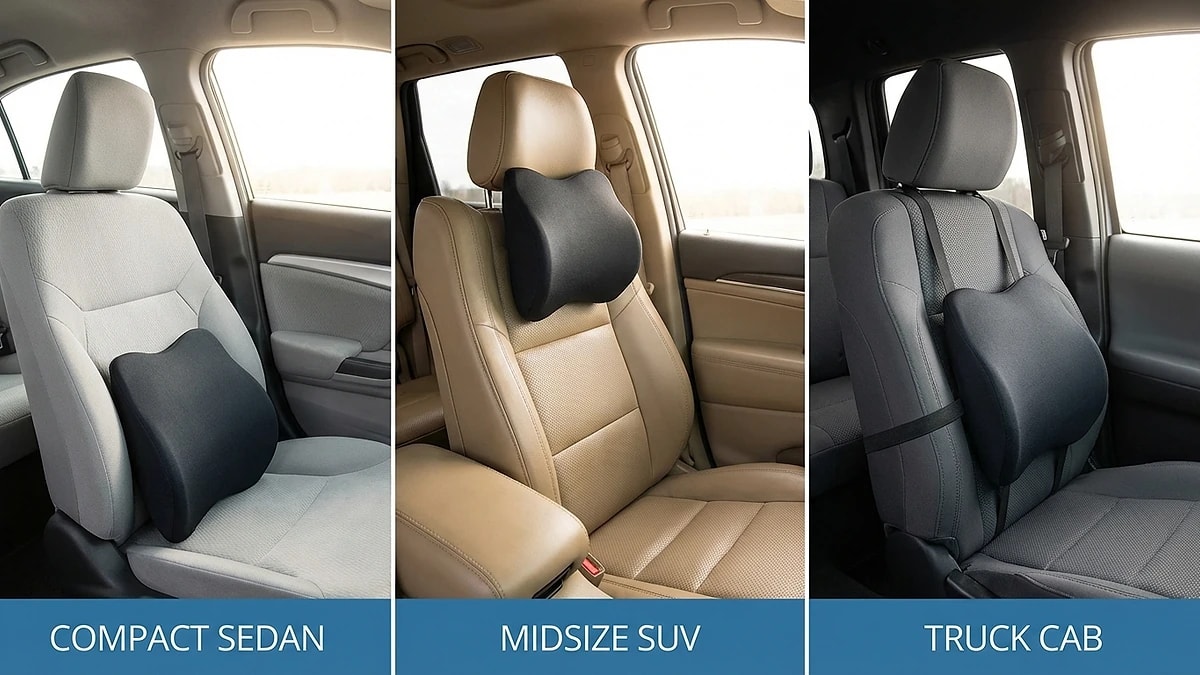
Sedans and compact cars typically have the most straightforward installation because their seat backs are relatively flat and accessible. Route the strap around the headrest post or through the seat gap, then tighten until the pillow sits firmly at your natural lumbar curve without any lateral movement when you turn the steering wheel. SUVs and trucks often have thicker, more contoured seats — in these vehicles, a strap that routes through the gap between the seat base and backrest usually provides more stability.

Many drivers use the same lumbar cushion across multiple vehicles — a personal car for commuting, a family vehicle for weekends, or a rental car during travel. Quick strap adjustment is the most important feature for multi-vehicle use. Mark your optimal strap position with a small piece of tape or a pen mark on the strap itself for each vehicle you use regularly. This eliminates the guesswork of refitting each time you switch cars.

  • Sedans: headrest post or seat gap strap routing works well
  • SUVs/trucks: seat gap routing often more stable than headrest routing
  • Mark optimal strap positions for each vehicle you drive regularly
  • Installation under 30 seconds encourages consistent daily use
Seat material compatibility

Seat material compatibility

Leather and vinyl car seats create a slippery surface that makes lumbar pillow retention more challenging. Anti-slip rubber backing or silicone grip dots on the pillow base are essential for these materials. Fabric seats provide more natural friction, which allows simpler attachment systems to work effectively.

For leather seats specifically, verify that the pillow backing material does not contain dyes or chemicals that could transfer to light-colored leather during hot weather. Placing a thin microfiber cloth between the pillow and leather surface prevents potential discoloration while maintaining grip. Clean the contact area monthly with appropriate leather conditioner to prevent the abrasion that repeated pillow contact can cause over time.

  • Leather/vinyl seats: require anti-slip backing or silicone grip
  • Fabric seats: natural friction allows simpler strap systems
  • Use microfiber barrier on light-colored leather to prevent dye transfer
  • Clean leather contact area monthly to prevent abrasion marks

Frequently asked questions

Can lumbar support be used in any car?

Most cars are compatible, but aggressive bucket seats may need slimmer profiles or alternate strap routing. Always test driving controls after installation.

How quickly should I feel improvement while driving?

Many users notice positioning benefits within days. Stable all-day comfort typically takes one to two weeks of consistent use.

Will this help on long road trips?

It significantly improves comfort consistency on drives over two hours. Combine with short movement breaks every 90 minutes for best results.

Does road vibration damage the lumbar pillow faster?

Yes, constant vibration accelerates foam fatigue compared to stationary use. Choose high-density foam and expect to replace approximately 20% sooner than office-use pillows.

Can I leave the lumbar pillow in a hot car?

Extreme heat above 140°F can permanently compress memory foam. Remove the pillow when parking in direct sun or choose gel-infused foam for better heat resistance.

Should I buy a pillow, cushion, or roll for my car?

Lumbar pillows offer broad support for most drivers. Rolls work better in tight sports seats. Many experienced users combine a lumbar pillow with a separate seat cushion for comprehensive comfort.

What foam density is best for car use?

Foam rated 3.5 to 4.5 pounds per cubic foot handles road vibration and daily compression best. Lower densities compress permanently too quickly.

Can one cushion be used in different cars?

Yes, if strap range and profile depth fit each seatback. Mark your strap positions per vehicle for quick switching.

How do I know if the pillow is too thick for my seat?

If your torso is pushed forward and you cannot maintain natural steering distance, the profile is too thick. Try a slimmer option under 3 inches.

Do straps damage car seats?

Properly designed adjustable straps should not damage seats when used as directed. Check for dye transfer on light leather during the first week.

Related guides

Explore these guides to learn more and find the right solution for your needs.