30-day money back guarantee | Spring sale — 40% off + free shipping

Kaip tai padaryti gidai

How to Test if Lumbar Support Fits Your Chair

A 5-step fit test protocol to verify lumbar support compatibility with your office chair, gaming chair, or car seat. Includes troubleshooting for common mismatches and clear pass/fail criteria.

How to Test if Lumbar Support Fits Your Chair

Pagrindiniai patarimai

Five repeatable checks tell you in 30 minutes whether support fits your chair.
Most fit failures are positioning errors, not product problems.
Record your test results before changing anything — one variable at a time.
The 5-step fit test protocol

The 5-step fit test protocol

This protocol works for any chair and lumbar support combination. Run through all five steps in order, recording each result before moving to the next. Step one: check the strap path — the strap should route securely around the chair back without sliding up or down during use. Step two: verify lumbar contact height — the center of the support should sit at the inward curve of your lower back, roughly at belt height.

Step three: check your torso angle — lean back and confirm your shoulders touch the chair without being pushed forward. Step four: assess seat pressure — your weight should distribute evenly without new pressure points at your sit bones or thighs. Step five: run a 30-minute seated session doing normal work and rate your end-of-session comfort. If all five steps pass, the fit is good. If any step fails, troubleshoot that specific dimension before changing the product.

  • Step 1: Strap path — secure, no sliding during use
  • Step 2: Contact height — center at belt-line lumbar curve
  • Step 3: Torso angle — shoulders touch chair, not pushed forward
  • Step 4: Seat pressure — even distribution, no new pressure points
  • Step 5: 30-minute session — comfort maintains or improves over time
Pass and fail criteria for each check

Pass and fail criteria for each check

Clear criteria eliminate guesswork. For the strap test, pass means the pillow stays in place through a full lean-back-and-sit-up cycle without repositioning — fail means it shifts more than two centimeters. For contact height, pass means you feel even pressure across the lumbar curve — fail means pressure concentrates at a single point above or below the curve. For torso angle, pass means natural shoulder position — fail means your upper back lifts off the chair or your chest tilts forward.

For seat pressure, pass means no new discomfort compared to sitting without the pillow — fail means you feel increased pressure at your sit bones, thighs, or tailbone (indicating the pillow is altering your pelvic position). For the 30-minute session, pass means comfort stays the same or improves — fail means you repositioned the pillow more than once or your comfort declined over the session. Record pass or fail for each step so you know exactly which dimension needs attention.

  • Strap: pillow stays within 2cm during full lean-back cycle
  • Contact: even pressure across lumbar curve, no point loading
  • Torso: shoulders rest naturally, no forward push or upper-back gap
  • Pressure: no new discomfort compared to baseline without pillow
  • Session: comfort maintains or improves, zero or one reposition max
Troubleshooting failed checks

Troubleshooting failed checks

When a step fails, adjust that specific dimension before changing anything else. Strap failure usually means the strap is routing around the wrong part of the chair — try threading it through the mesh, around a different cross-bar, or using a non-slip pad. Contact height failure is the most common: move the pillow up or down by one centimeter and retest. Most users need two or three micro-adjustments before finding the ideal height.

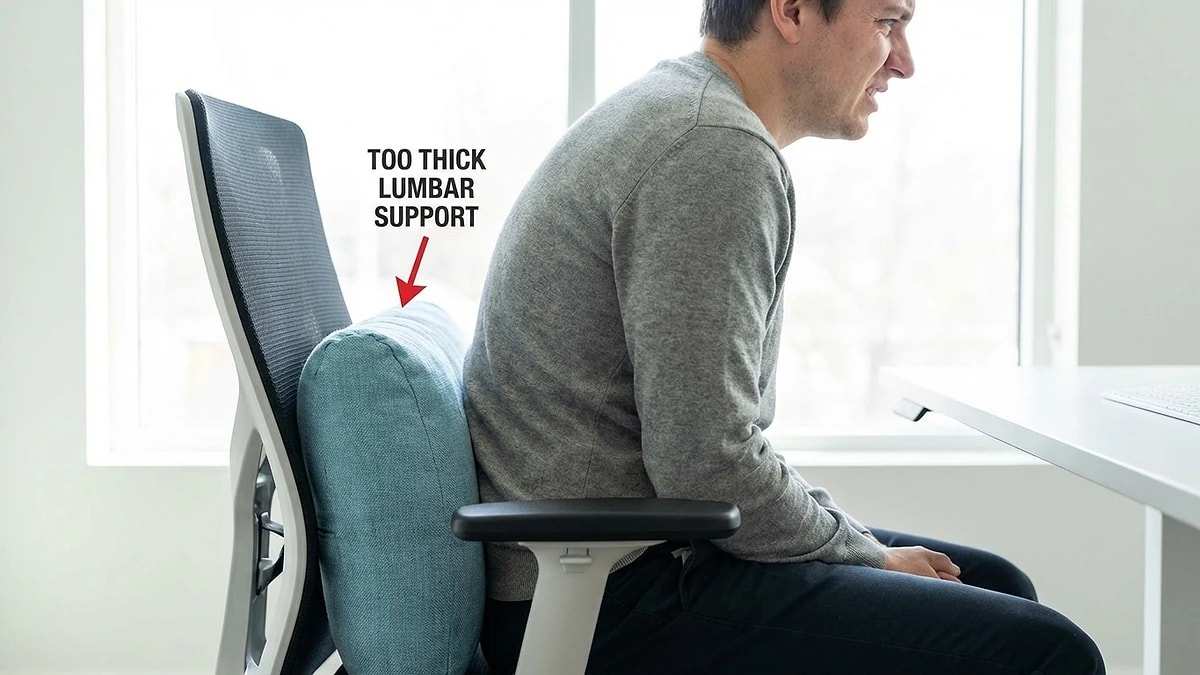
Torso angle failure means the pillow profile is too deep for your chair — either the pillow is too thick or the chair back is already heavily contoured. Try rotating the pillow 180 degrees (many contoured pillows have a flatter side) or switching to a thinner profile. Seat pressure failure usually indicates the pillow is tilting your pelvis forward, which redistributes weight to your thighs — lower the pillow position slightly. If the 30-minute session fails despite other steps passing, give it three more sessions before deciding — muscle adaptation takes time.

  • Strap fail: reroute through mesh or add non-slip pad
  • Height fail: move 1cm up or down and retest — most common fix
  • Torso fail: try flatter side of pillow or thinner profile
  • Pressure fail: lower pillow position to correct pelvic tilt
Adapting the test for different chair types

Adapting the test for different chair types

Gaming chairs require two additional checks beyond the standard five: recline stability (does the pillow maintain contact through your chair's full recline range?) and bolster clearance (do side bolsters pinch or push the pillow edges?). Many gaming chairs have aggressive side bolsters that compress narrower lumbar pillows, reducing effective support width. If your gaming chair's built-in lumbar pillow failed this test, an aftermarket pillow with a wider profile often solves the problem.

Car seats add their own dimensions: vibration drift (does the pillow stay put after 20 minutes of driving?) and safety clearance (can you still reach all pedals and controls?). For mesh office chairs, check whether the strap system works with the mesh tension — some mesh chairs stretch enough that straps loosen over time. Kneeling chairs and ball chairs generally cannot support external lumbar pillows and are not compatible with this test protocol.

  • Gaming: add recline stability and bolster clearance checks
  • Car: add vibration drift and safety clearance checks
  • Mesh chairs: verify strap holds against mesh tension over time
  • Kneeling and ball chairs: not compatible with external lumbar support

Dazniausiai uzduodami klausimai

How long should each test run take?

The first four steps take about 5 minutes total. The 30-minute seated session is the critical fifth step. Do not skip it — short tests miss the discomfort that develops over time.

What is the most common fit error?

Placement too high or too low relative to the lumbar curve. This single error accounts for most failed fit tests and is fixed by moving the pillow one to two centimeters.

Can this method work for gaming chairs?

Yes, with two additional checks for recline stability and side-bolster clearance. Gaming chairs with aggressive bolsters may need a wider-profile lumbar pillow.

Should I test with a warm or cold pillow?

Memory foam is temperature-sensitive — it firms up when cold and softens when warm. Test at room temperature for the most representative results.

What if the pillow passes all tests but still feels wrong after a week?

Your muscles may be adapting to the new posture. Give it a full two weeks of consistent use before concluding the fit is wrong. If discomfort increases rather than decreases over that period, the profile depth likely needs changing.

Susije gidai

Naršykite šiuos gidus, kad sužinotumėte daugiau ir rastumėte tinkamą sprendimą.